
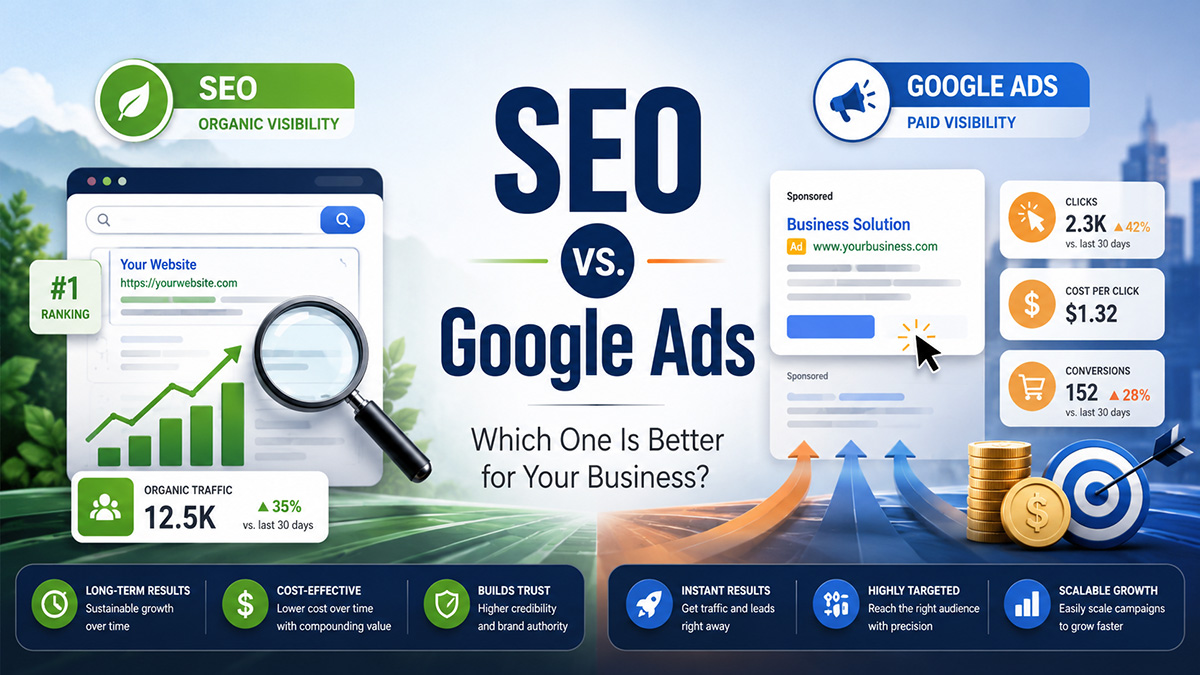
When business owners want more leads, calls, form fills, or online sales, two of the most common digital marketing options are SEO and Google Ads. Both can help your business appear in front of people searching for your services, but they work in very different ways.
SEO, or search engine optimization, focuses on improving your website’s organic visibility in search results. Google Ads, also known as paid search or PPC, allows you to pay for placement at the top of Google for specific keywords.
So which one is better for your business?
The honest answer is: it depends on your goals, timeline, budget, competition, and current online presence. For many businesses, the strongest strategy is not choosing one over the other, but understanding how SEO and Google Ads can work together to create both short-term and long-term growth.
What Is SEO?
SEO is the process of optimizing your website so it can rank higher in organic search results. These are the unpaid listings that appear below paid ads and other search features.
A strong SEO strategy may include keyword research, content optimization, technical improvements, local SEO, Google Business Profile optimization, internal linking, page speed improvements, schema markup, and ongoing content creation.
For a local service business, SEO may focus on ranking for searches such as “roofing company near me,” “divorce lawyer in Long Island,” “Seattle HVAC contractor,” or “business broker near me.” These searches often come from people who are actively looking for a provider, which makes SEO valuable for lead generation.
SEO is not instant. It takes time to build authority, improve rankings, and earn trust with search engines. However, once your website gains visibility, SEO can become one of the most powerful long-term marketing assets for your business.
What Are Google Ads?
Google Ads is a paid advertising platform that allows businesses to appear in sponsored search results. Instead of waiting for organic rankings to improve, you can bid on keywords and pay when someone clicks your ad.
For example, if you are a contractor, attorney, HVAC company, roofer, painter, or medical provider, you can run ads for high-intent searches related to your services. When someone clicks your ad, they are taken to your landing page or website.
Google Ads can generate traffic quickly. This makes it useful for new businesses, seasonal promotions, emergency services, competitive markets, or companies that need leads right away.
The tradeoff is that every click has a cost. Depending on your industry and location, cost-per-click can range from relatively low to very expensive. In competitive industries such as law, home services, finance, insurance, or medical services, clicks can cost significantly more because many businesses are competing for the same leads.
SEO vs. Google Ads: What Is the Main Difference?
The biggest difference between SEO and Google Ads is how visibility is earned.
With SEO, you earn visibility organically by building a stronger, more helpful, and more technically sound website. With Google Ads, you buy visibility by paying for ad placements.
SEO is a long-term investment. Google Ads is a short-term traffic driver. SEO can continue producing traffic even after the initial work is done, while Google Ads usually stops producing traffic once the ad budget stops.
That does not mean one is automatically better than the other. Each has its place in a smart digital marketing strategy.
The Benefits of SEO
One of the biggest benefits of SEO is long-term value. Once your website starts ranking well for important keywords, it can generate traffic and leads consistently without paying for every individual click.
SEO also helps build trust. Many users naturally view organic listings as more credible than paid ads, especially when the website provides helpful content, strong service pages, reviews, case studies, FAQs, and local relevance.
Another advantage is that SEO supports your entire online presence. A properly optimized website can help improve visibility across traditional search, local map results, answer engines, and AI-powered search experiences. Well-written content that directly answers customer questions can also help your business appear in featured snippets, People Also Ask results, and AI-generated summaries.
For service-based businesses, SEO is especially powerful when combined with local optimization. City pages, service-area content, Google Business Profile optimization, local reviews, and locally relevant blog content can help attract customers in specific towns, neighborhoods, and surrounding areas.
The Drawbacks of SEO
SEO takes time. It is not usually the best option if you need leads tomorrow. Depending on your market, competition, website condition, and budget, it can take months to see meaningful ranking improvements.
SEO also requires consistency. Search engines reward websites that are regularly improved, technically healthy, and supported by useful content. A one-time SEO setup may help, but long-term results usually require ongoing attention.
Another challenge is competition. If your competitors have older domains, stronger backlink profiles, more reviews, better content, and more optimized service pages, your business may need a more aggressive SEO plan to catch up.
The Benefits of Google Ads
Google Ads can produce visibility almost immediately. Once a campaign is built, approved, and launched, your business can appear for targeted keywords and start driving traffic.
This is valuable for businesses that need quick leads, want to promote a specific service, or are entering a competitive market where organic rankings are not yet established.
Google Ads also gives you more control over targeting. You can choose locations, keywords, ad schedules, devices, demographics, budgets, and landing pages. You can also test different messaging to see what generates the best response.
Another major benefit is data. Google Ads can show which keywords, ads, and landing pages produce calls, form fills, and conversions. That data can also help inform your SEO strategy by showing which search terms are most valuable.
The Drawbacks of Google Ads
The biggest drawback of Google Ads is cost. Since you pay for each click, a poorly managed campaign can waste money quickly. If your ads target the wrong keywords, send users to weak landing pages, or lack conversion tracking, your budget may disappear without producing quality leads.
Cost-per-click can also be high in competitive industries. For example, legal, insurance, home improvement, medical, and financial keywords can become expensive because many companies are bidding for the same audience.
Google Ads also does not build the same long-term organic value as SEO. When your budget stops, your ads stop. This makes paid search powerful, but not always sustainable as the only marketing channel.
What Is Cost-Per-Click and Why Does It Matter?
Cost-per-click, often called CPC, is the amount you pay when someone clicks on your Google ad.
CPC matters because it directly affects your return on investment. If clicks cost $5 and your landing page converts well, your campaign may be profitable. But if clicks cost $75 and your website does not convert visitors into leads, the campaign can become expensive very quickly.
However, CPC should not be judged by cost alone. A higher-cost click may still be worth it if the lead value is high. For example, a law firm, contractor, or business broker may be willing to pay more for a click because one new client can produce significant revenue.
The real question is not just, “How much does a click cost?” The better question is, “How much does it cost to generate a qualified lead, and what is that lead worth to the business?”
Which Is Better for Long-Term ROI?
For long-term ROI, SEO often has the advantage. Once your website gains rankings, authority, and traffic, it can continue generating leads without paying for every click.
A strong SEO campaign can also increase the value of your website over time. Every optimized service page, blog post, FAQ section, city page, review signal, and technical improvement can support future visibility.
That said, SEO is not free. It requires investment in strategy, content, technical work, website improvements, and ongoing optimization. The difference is that SEO builds an asset, while Google Ads buys traffic.
Google Ads can still produce excellent ROI, especially when campaigns are carefully managed and landing pages are designed for conversion. But because paid ads require continuous spending, they are usually strongest when combined with a long-term SEO strategy.
When Should a Business Use SEO?
SEO is a strong choice when your business wants to build long-term visibility, reduce dependency on paid ads, and become more discoverable in organic search.
SEO is especially important if customers regularly search for your services online. Local businesses, professional service providers, contractors, medical practices, attorneys, real estate companies, and home service companies can all benefit from strong organic visibility.
You should consider SEO if:
Your website is not ranking well for important keywords.
Your competitors appear above you in local search results.
You want more organic traffic and leads over time.
You want to build authority in your industry.
You want to rank in multiple cities, towns, or service areas.
You want your website to support AI search, answer engines, and Google’s evolving search results.
SEO is also essential if your website has technical issues, thin content, poor mobile performance, slow loading speed, or weak service pages.
When Should a Business Use Google Ads?
Google Ads is a strong choice when your business needs immediate visibility or wants to test a market quickly.
It can be especially useful for new businesses that do not yet rank organically, seasonal businesses that need traffic during a specific time of year, or companies promoting high-value services.
You should consider Google Ads if:
You need leads quickly.
Your SEO campaign is still growing.
You want to target specific high-intent keywords.
You are promoting a time-sensitive offer.
You want to test which services or locations convert best.
You have a strong landing page that can turn visitors into leads.
Google Ads can also help fill gaps while your SEO strategy builds momentum.
When Should You Use SEO and Google Ads Together?
For many businesses, the best answer is both.
SEO and Google Ads can work together to create a stronger digital marketing strategy. Google Ads can generate immediate traffic while SEO builds long-term organic visibility. Over time, your SEO rankings may reduce your dependency on paid clicks, while Google Ads can continue supporting competitive keywords, seasonal campaigns, and high-value services.
Using both channels can also give your business more visibility on the search results page. If your business appears in both paid and organic listings, you increase your chances of being seen, clicked, and remembered.
Google Ads data can also improve your SEO strategy. If certain paid keywords produce strong leads, those keywords may be worth targeting with organic service pages, blog content, or landing pages.
Likewise, SEO can improve paid ad performance. A faster, better-designed, more trustworthy website can increase conversions from paid traffic. If your website is confusing, outdated, or slow, both SEO and Google Ads will suffer.
Your Website Matters No Matter Which Strategy You Choose
Whether you invest in SEO, Google Ads, or both, your website plays a major role in success.
Traffic alone does not guarantee results. Your website must convert visitors into leads. That means your pages should have clear headlines, strong calls to action, fast load times, mobile-friendly layouts, helpful content, trust signals, reviews, service details, and easy contact options.
For example, if someone clicks an ad or finds your business through organic search, they should immediately understand what you offer, where you serve, why they should trust you, and how to contact you.
A strong website is the foundation of both SEO and Google Ads. Without it, you may attract visitors but lose potential customers.
Which One Should Your Business Choose?
Choose SEO if you are focused on long-term growth, brand authority, organic visibility, and reducing your reliance on paid traffic.
Choose Google Ads if you need faster results, want immediate traffic, or need to promote a specific service in a competitive market.
Choose both if you want the most complete strategy: immediate lead generation from paid search and long-term visibility from organic search.
For most businesses, the smartest approach is to use Google Ads for short-term visibility while investing in SEO for long-term growth. This creates a balanced marketing strategy that can generate leads now while building a stronger online presence for the future.
Build a Smarter Search Strategy for Your Business
SEO and Google Ads are not enemies. They are different tools with different strengths. SEO helps your business build trust, authority, and long-term visibility. Google Ads helps you reach customers quickly when they are actively searching.
The right strategy depends on your business goals, competition, budget, and timeline. If your website is well-built, your messaging is clear, and your campaigns are properly managed, both SEO and Google Ads can help your business grow.
At Spike Interactive, we help businesses improve their online presence through SEO, Google Ads, website design, and website development. Whether you need stronger organic rankings, better paid search performance, or a website designed to convert more visitors into leads, our team can help you build a strategy that supports real business growth.